Keyboard Builders' Digest / Projects
Poly Keyboard
The Poly Keyboard by thpoll has tiny OLED displays in each keycap to showcase the actual function of the keys.

Published June 11, 2022
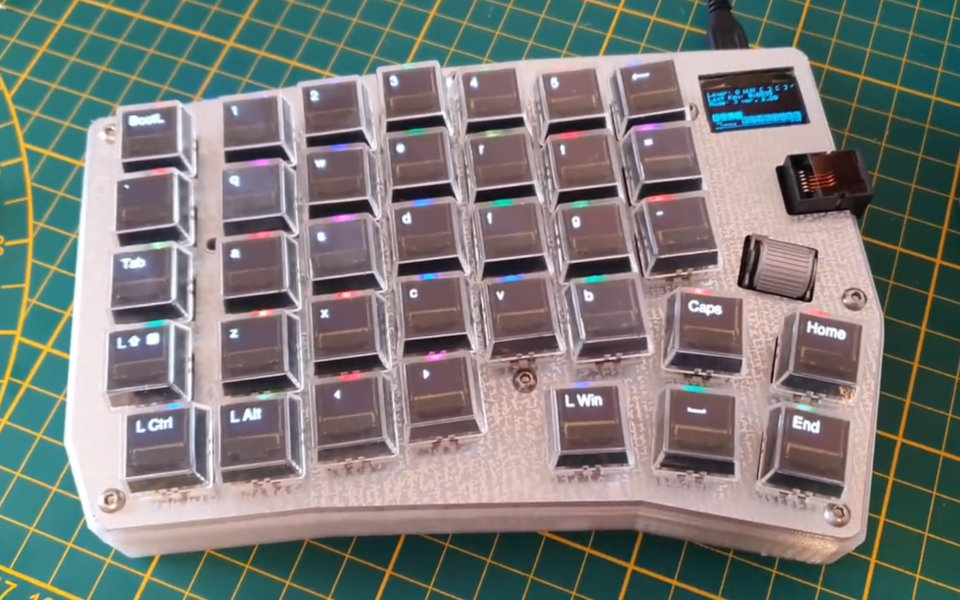
Thomas aka thpoll has been developing his Poly Keyboard for some time. The project is still work in progress, however, he posted a promising video this week:
Yes!! Left side of the split keyboard works! #MechanicalKeyboard #OLED pic.twitter.com/2shKk43PQw
— thpoll (@thpoll2) June 9, 2022
So what is this project about? In Thomas's words, the Poly Keyboard is a keyboard "that speaks any language with OLED displays in its keycaps".
I was actually just experimenting with displays/Arduino and coincidentally found out that one of these displays had the size of a keycap (it was a 0.49" 64x32 OLED display on a PCB with an I2C interface) – thpoll.
Wait a second before you head to Aliexpress! :D The size was less then 1U (19.05mm) but still too big to fit into an ordinary keycap, so Thomas printed some custom caps with transparent PETG – then found an even smaller display:
I came across this 0.42" OLED display which is sold in bigger quantities on Alibaba for about 1$ each!
(Now you can head to Alibaba… :D This way.)
So, while you could argue that any programmable keyboard can handle the characters of any language, those characters are actually displayed here: the PolyKB, a "polylingual keyboard", has these tiny little OLED screens in each keycap.
We've seen similar projects before (e.g. Butterfly Company's Touchboard), but this one is more sympathetic probably because of the complete lack of unnecessary marketing buzzwords.
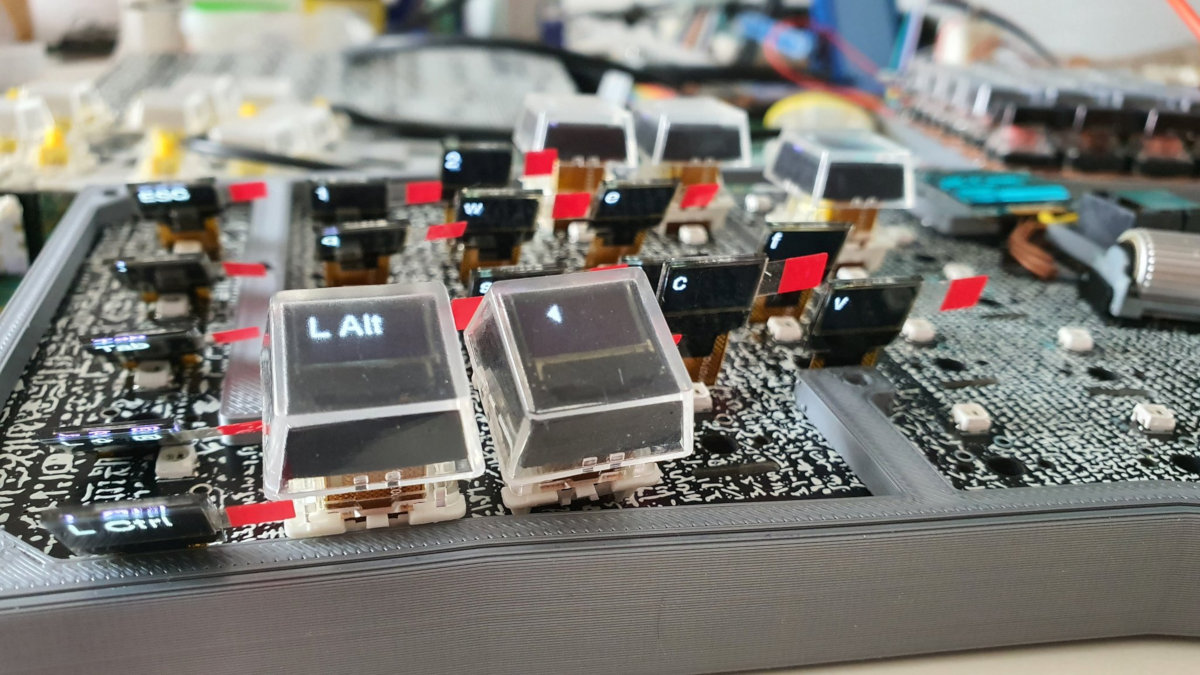
The aluminum plate and the PCB both have a silk screen added. The scribble was very familiar and it turns out it fits a keyboard supporting multiple languages perfectly: the Rosetta Stone.

However, the displays sitting inside the caps are more interesting.
The "relegendable" two-part keycap has a 3D-printed stem to get the FFC through.
While designing the PCB in KiCad, Thomas used switch footprints with a small extra slot for the OLED's FCC/FFC cable:

As you can see, the board is driven by a Raspberry Pi Pico (RP2040) controller:

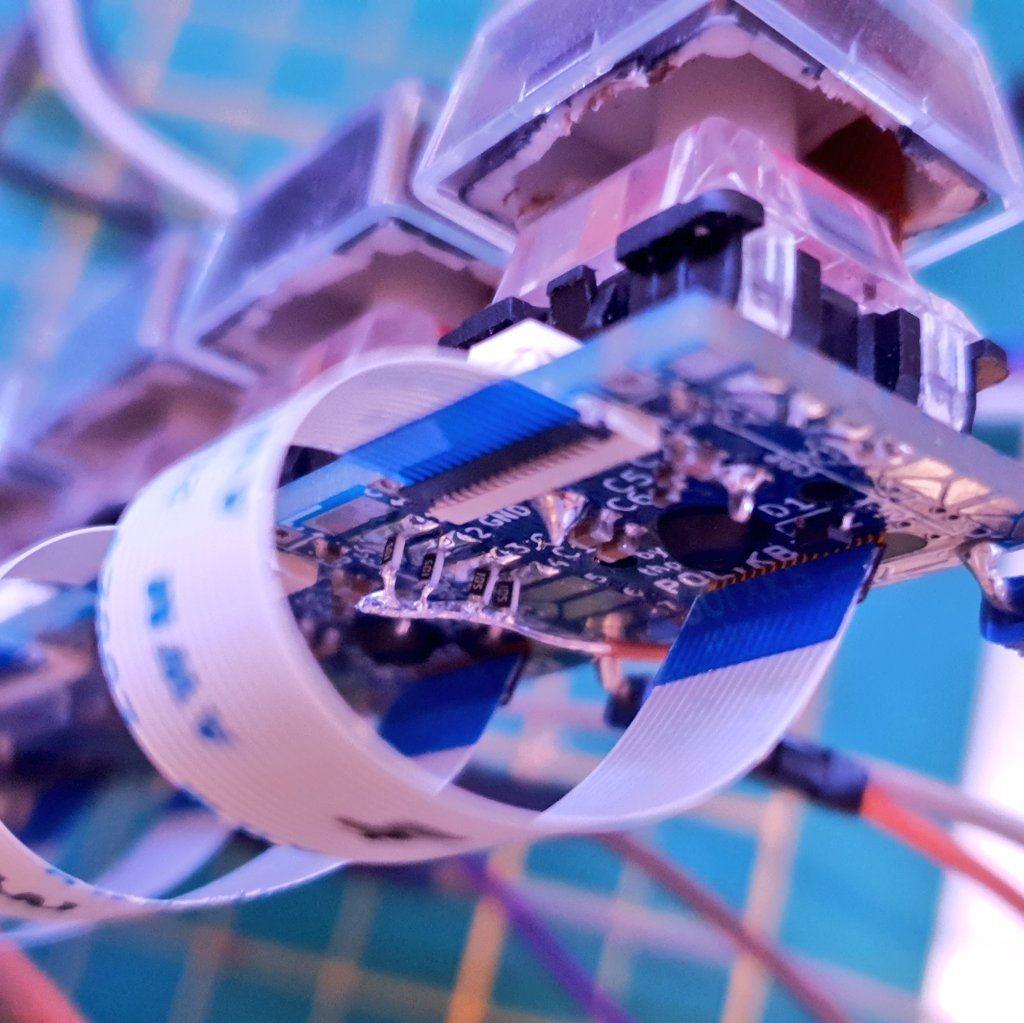
As a proof of concept, a 4x2 macropad and a larger numpad was built. Here you can see the flexible cables under the hood of one of these early prototypes:
Thomas hopes to get a dev kit ready at some point. In addition, the project will be open source/hardware.
For more info, check out this Twitter thread, and the author has some excellent write-ups on the design and development process on ko-fi as well, diligently documenting the project. Once on ko-fi, support his work if you can.
Finally, while still work in progress, the project has its GitHub repo here.
Careful though:
In my posts you can find references to my project on github, just be aware that these are not always up-to-date. Once reaching a more 'production ready' state I'll tidy up a bit – thpoll.
Published on Sat 11th Jun 2022. Featured in KBD #82 (source).
Related

Chunky
The Chunky by tenstaana is a split board featuring Blackpill, Choc switches, audio, trackball and trackpoint.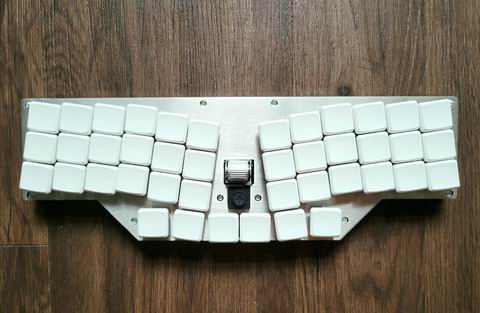
A low profile portable BLE design
A new low profile portable BLE design by SouthPawEngineer with scroll wheel.
SlabV
SlabV by u/brickbots is a 36% keyboard with stacked acrylic construction and silicone gaskets.
C-13X keyboard
The C-13X is a tiny Alice-like handwired keyboard with an open-source case by u/flurpyflurples.